What is the APRS ?
APRS for Automatic Packet Reporting System, is a digital radio system used by amateur radio, which allows sharing between stations of local interest. The best known use of APRS is the transmission of the geographical position of the stations or other items related to the activity of radio amateurs. APRS is based on the same protocol as packet radio, AX25, the amateur version of X.25.
We often give a different translation of the acronym APRS (false for the designers of the system): Automatic Position Reporting System.
Basically, the APRS is a packet communication protocol to stream live data to all users of the network, and in real time. Its main feature is the combination of packet radio with the Global Positioning System satellite (GPS) network, enabling radio amateurs to automatically display the radio stations and positions of various objects on maps displayed on the PC. Other possibilities that are not directly related to the automatic monitoring of positions are also available such as weather reports, research and tag messages.
APRS is different from the common packet on several aspects:
- Allows viewing cards and other data for the location of vehicles and people and weather reports in real time.
- Immediately performs the update users through one packet frame!
- Uses a generic repeater with identical codes to allow standardization globally, so it is not necessary to know the network classification.
- Enables intelligent repetition with substitution codes to reduce network congestion.
- Using Unproto AX.25 frames, supports bilateral transmission of messages, distribution of newsletters and announcements, leading to the rapid flow of information in text form.
- Supports communication with TX Kenwood TH-D7 and TM-D700, Yaesu VX8-G and FTM-350, devices incorporating TNC and APRS firmware.
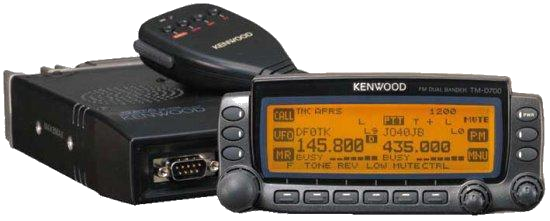
Kenwood TM-D700
The conventional packet radio is only useful for sending large messages, and is traditionally difficult to apply to events in real time where the information has a short lifespan. APRS turns packet radio into a visualization system and tactical real-time communication for emergencies and the general interest.
APRS allows the universal connection of all stations, but avoids the complexity, the size and boundaries of a network requiring connections. It allows a large number of stations to exchange data such as people would in a meeting. Any station with information to bring just sends, and all users will receive it.
APRS allows for special events or emergency the real-time location of key stakeholders. Where is the marathon leader? Where are the emergency vehicles? What's the weather like in different places of the region? Where fallen power lines? Where is the head of the parade? Where is the car with ATV camera? Where is the storm? Where is the nearest hospital?
To answer these questions, APRS provides automatic and comprehensive monitoring of positions and status of vehicles. It can be used with any 2-way radio system including amateur radio, marine band, and mobile phones. There is even an international APRS network location live on the Internet.
Frequencies
Europe: VHF: 144.800 MHz / UHF: 439 700 Mhz
United States: 144 390 Mhz
Australia: 145 175 Mhz
Asia (Thailand, Myanmar, Pakistan, India, Cambodia, Vietnam, Laos, etc.): 145 525 Mhz
Details of my APRS station
Base Station :
A Yaesu FTM-350 for sending frames APRS (Position, messages), connected to a Diamond SG-7900 mobile antenna.
Kenwood TM-D700 serving as an Igate UHF ➜ TCP. The antenna used is a Diamond X7000 length of 5.00m. It is installed in the attic of the station, vertical. Why not directly on the roof? Aesthetic concerns for neighbors and also a fear of lightnings.
What is an Igate?
For APRS stations can appear on the Internet (see the site aprs.fi in the "Links" tab on this site), it is necessary that the frames are captured on the air, then sent over the Internet. An Igate has this feature. It is also possible to do the reverse: send frames received over the Internet on the air.
Operation of my Igate:
Once the frames received by the TNC of the TM-D700, they are sent in an industrial PC via RS-232.
The UIView software does the rest. It is connected to a remote server and sends APRS all frames received on the internet.
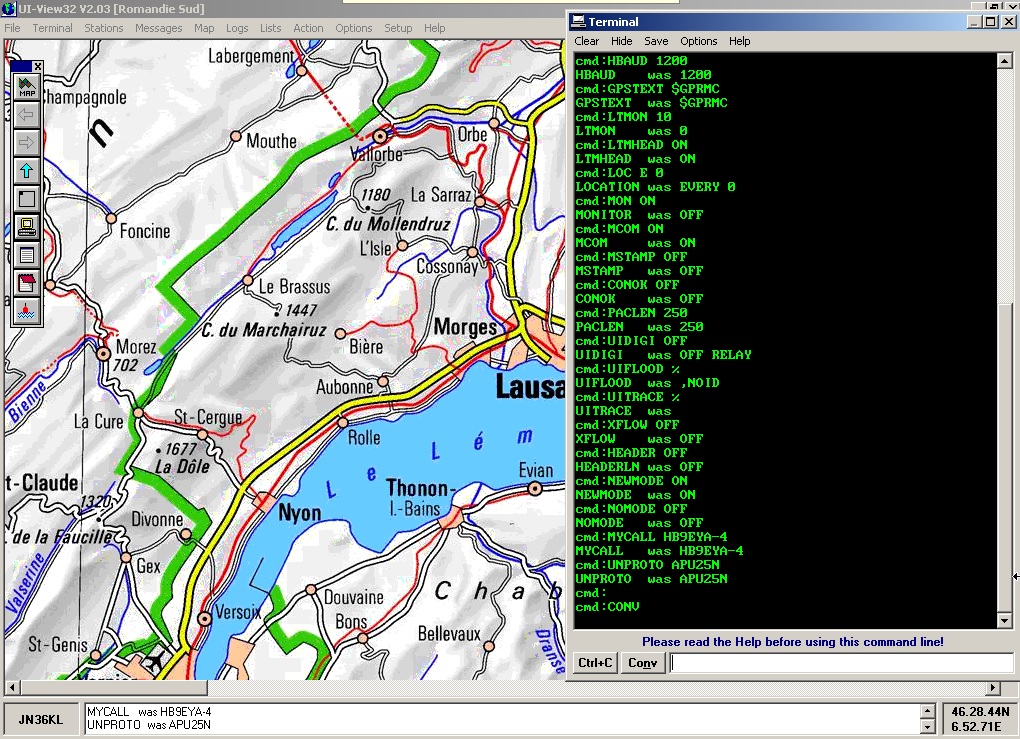
Screenshot of UIView
Frames relayed by HB9G-4 pass through my Igate, thereby the reception coverage is relatively large.
Many people use the VHF frequency (144.800 MHz) to the detriment of UHF in Switzerland.
There is very little traffic on that frequency, but I do not want to see disappear APRS on UHF, which is why I kept this Igate active.
APRS map of my area
You can view the activity in Switzerland via the following shortcut and locate my station: APRS.fi
Mobile Station
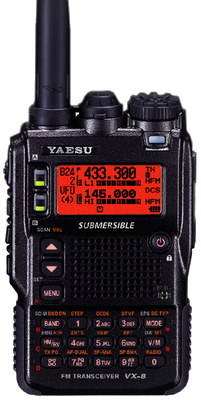
VX8
Misc. information
On Android, the application "APRSdroid" uses the GPS of the device for location and sends the frames directly on the Internet.
The application is available on the Google PlayStore. You must hold an amateur radio license to use it.

APRSdroid Logo
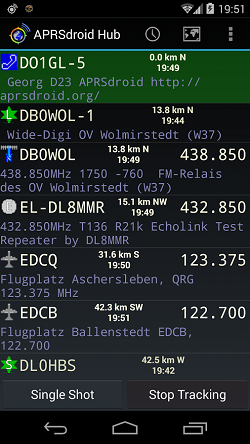

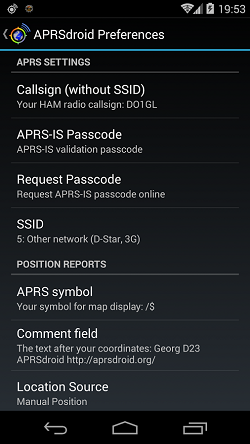
Screenshot
It is also possible to communicate with the international space station in various modes, including APRS (Packet). See the link for "Amateur Radio on the International Space Station (ARISS)" in the "Links" tab.
Voice and SSTV Downlink: 145.80 (Worldwide)
Voice Uplink: 144.49 for ITU Regions 2 and 3 (The Americas, and the Pacific and Southern Asia)
Voice Uplink: 145.20 for ITU Region 1 (Europe, Russia and Africa)
VHF Packet Uplink and Downlink: 145.825 (Worldwide)
UHF Packet Uplink and Downlink: 437.550
UHF/VHF Repeater Uplink: 437.80
UHF/VHF Repeater Downlink: 145.80
Acknowledgements