But what are the ACARS ?
ACARS messages (for Aircraft Communications Addressing and Reporting System) are coded messages exchanged between a (the) plane (s) and the ground. The system allows data exchange especially between air navigation services (controllers), allowing unclog frequencies. The service is also used by companies to exchange information with their crews, or by planes that can automatically send messages to the company maintenance services on any breakdowns, allowing to anticipate repairs.
We have heard a lot about those famous messages in the disappearance of flight AF447, since the latest information received from the flight have been via the ACARS system..
Technically, the system can use three different vectors :
- VHF transmission systems on the aircraft band.This system is inexpensive but has the disadvantage of having a limited range, the VHF band has an optical scope.
- A satellite transmission is mainly used in ocean overflights to ensure service throughout the crossing, but it is much more expensive to set up, besides it does not cover all world regions, including polar regions.
- That's why it was set up more recently transmitting ACARS messages over the HF band. The range is several thousand kilometers.
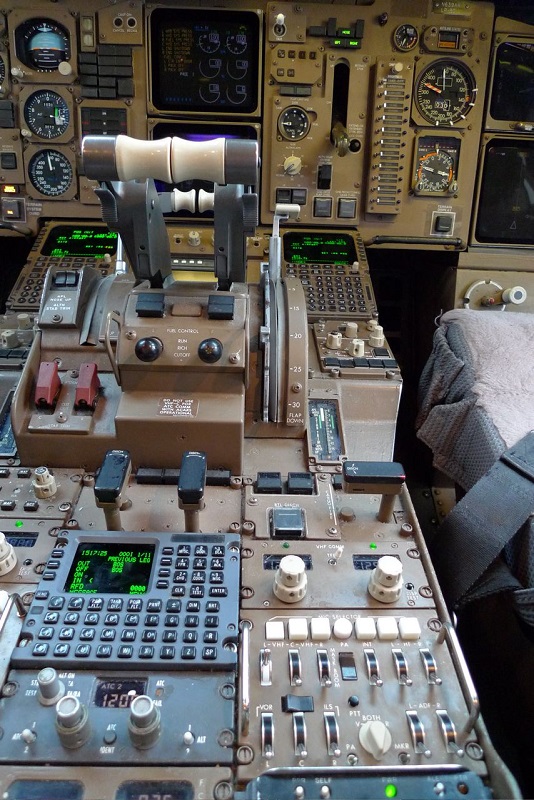 Center console of a Boeing 757 – the gray box with a keyboard and a screen is used for sending ACARS messages – Credits Kent Wien
Specifically, these text messages are digital messages. We therefore use a modem-like device (modulator / demodulator) for modulating the digital messages into analog signals (as was done at the beginning of the Internet era with PSTN "Public Switched Telephone Network" lines) according to a standard set by the 'AIRINC from 1978 (which has subsequently been adopted gradually by airlines in the 80s, now it is a system used quite heavily by the airlines).
We can try to list the different uses of the ACARS system (not exhaustive) :
- Flight Plan transmission
Center console of a Boeing 757 – the gray box with a keyboard and a screen is used for sending ACARS messages – Credits Kent Wien
Specifically, these text messages are digital messages. We therefore use a modem-like device (modulator / demodulator) for modulating the digital messages into analog signals (as was done at the beginning of the Internet era with PSTN "Public Switched Telephone Network" lines) according to a standard set by the 'AIRINC from 1978 (which has subsequently been adopted gradually by airlines in the 80s, now it is a system used quite heavily by the airlines).
We can try to list the different uses of the ACARS system (not exhaustive) :
- Flight Plan transmission
- Transmission of technical information to the airline's maintenance services (this information can be automatically transmitted without crew intervention by the aircraft systems).
- Useful information communication between the crews and the various services of airlines
- Clearances transmission control in areas not covered by voice or before departure at airfields
Aboard the plane, the ACARS messages are decoded by the aircraft systems and printed in the cockpit for beings brought to the attention of the crew. Messages can be sent by the crew through a screen and most often located on the center console keypad (see above photo).
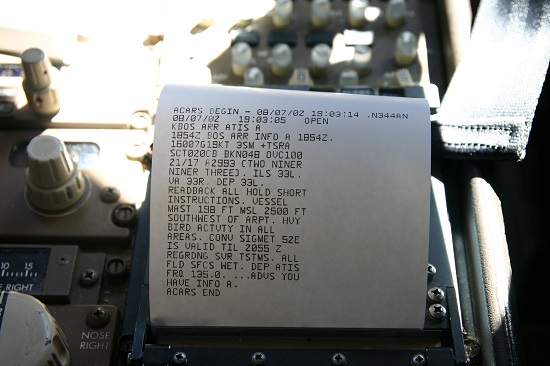 ACARS message printer from a Boeing 757 – Credits Kent Wien
I discovered that we can easily decode ACARS messages, simply by equipping a receiver on the aircraft band and a PC. A sound card is only a system capable of analyzing audio, you can use it to record the modulated ACARS messages. Then simply use software capable of demodulating the signals received and voila!
ACARS message printer from a Boeing 757 – Credits Kent Wien
I discovered that we can easily decode ACARS messages, simply by equipping a receiver on the aircraft band and a PC. A sound card is only a system capable of analyzing audio, you can use it to record the modulated ACARS messages. Then simply use software capable of demodulating the signals received and voila!
On the main page dedicated to ACARS, you can scroll through the messages I receive in real time, when my station is active, or the last 20 received before it is turned off.
I usually active later in the day. Check the arrival time of messages!
The ACARS network
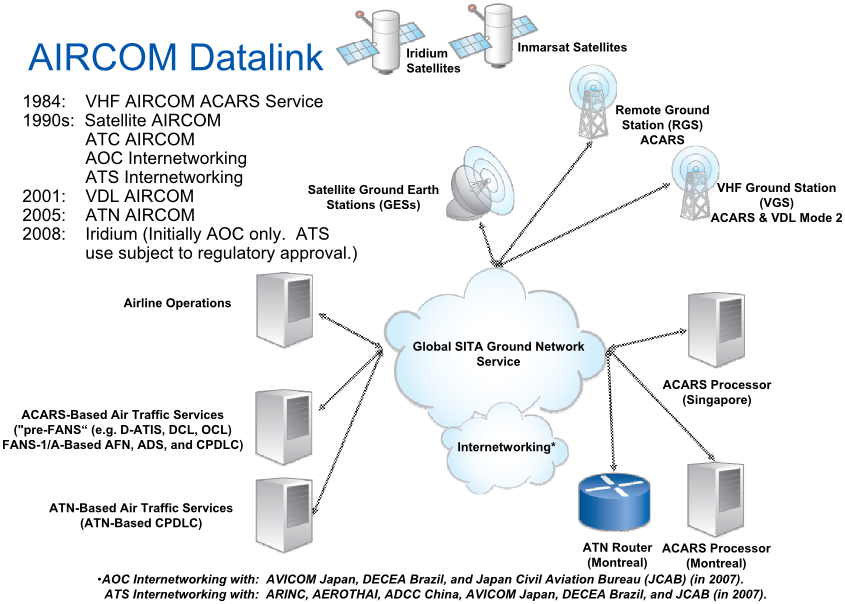
ACARS messages pass through a network managed by SITA (International Society of Aeronautical Telecommunications). The network is gradually since its creation in 1984, the ACARS were then transmitted only by VHF, via the Remote Ground Stations (RGS). The network gradually evolved to integrate transmission via HF frequencies between 1995 and 2001 and the introduction of satellite transmissions (Inmarsat in the 1990s and Iridium in 2008). Here is a summary diagram of the network in 2009 (close enough or consistent with the current network.) :
>
Diagram of the ACARS network SITA
Diagram of the ACARS network SITA
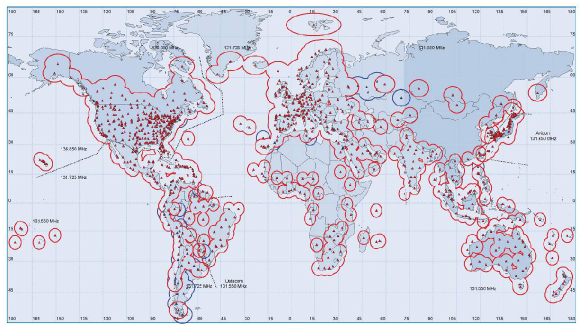 ACARS VHF link coverage
Use of information
ACARS messages are unfortunately mostly quite difficult to interpret. There is to my knowledge no software on the net that can decode ACARS and turn it into intelligible message.
Here are a few examples received by my station :
ACARS Mode: e Aircraft reg: .OO-SNE
Message Label: 30 Block ID: V [Uplink]
Message content:-
2

LITOW 52.3

MACZFW 26.1

MACTOW 26.0

FUEL DENSITY 0.8

A16 B34 C15

SEATROW TRIM

SI DOW 42382

SALEABLE CONFIGURATION 16C/144Y

PAX WEIGHTS USED M88 F70 C35 I0

PANTRY CODE S

CHECKED BAGGAGE PIECE
----------------------------------------------------------[23/05/2016 18:58]-
ACARS Mode: e  Aircraft reg: .PH-EXA
Message Label: 3B Block ID: V [Uplink]
Message content:-
7

AMS    BAG     135    FRE     709    POS       0

PANTRY CODE  C

NOTOC: YES

SECURITY SEARCH NOT PERFORMED BY CREW

APPRVD BY BAS KAPAAN

END OF MESSAGE
----------------------------------------------------------[23/05/2016 19:31]-
ACARS mode: E Aircraft reg: .D-ACNF
Message label: B4 Block id: 6 Msg. no: M20A
Flight id: LH1251
Message content:-
/GVADCYA.DC1/CDA 1731 160524 LSGG PDC 984

DLH9K CLRD TO EDDF OFF 05 VIA MOLUS3N

SQUAWK 1000 ATIS D

TSAT 1735 REPORT FULLY READY ON 121.675E32F
-----------------------------------------------------------[24/05/2016 19:31]
ACARS Mode: e  Aircraft reg: .PH-EZT
Message Label: A4 Block ID: Y [Uplink]
Message content:-
/GVADCYA.FS1/FSM 1720 160521

LSGG

KLM58V RCD REJECTED

REQUEST TOO EARLY

SEND REQUEST 15 MIN

BEFORE TOBT

F68A
----------------------------------------------------------[21/05/2016 19:21]-
 -=[ Uplink message ]=-
 ACARS mode: e  Aircraft reg: F-HBXL  [Embraer ERJ-170-100LR]  []
 Message label: A9 [Deliver ATIS information]  Block id: U
 Message content:-
 ORT OF INNER RWY
 WIP ON TWY
 BIRD HAZARD

WIND 310/12 KT
VIS 10 KM
CLD
  SCT 1300 FT
  BKN 3000 FT
T+16 DP+13QNH 101434E6
----------------------------------------------------------[21/05/2016 19:21]-
 -=[ Uplink message ]=-
 ACARS mode: 2  Aircraft reg: A6-AFA  [Airbus A330-343]  []
 Message label: 3S Block id: E
 Message content:-
LOADSHEET FINAL 034 2010
EY52/24 24MAR17 A333
GVA AUH A6AFA 2/11
BW    125689
DOW   130950
ZFW  165542 MAX 175000
TOF   49493
***********
TOW  215035 MAX 233000
***********
TIF   34200LAW  180835 MAX 187000 L
----------------------------------------------------------[24/03/2017 20:11]-